


Premier Clinic
Procedure

Fractional resurfacing

CO₂ fractional resurfacing is a laser treatment designed to address skin concerns such as pigmentation, scars, enlarged pores and acne-prone skin.

Book a consultation
Cost of the procedure
price depending on the extent of the treatment
Positives
CO₂ fractional resurfacing treats pigmentation, scars, enlarged pores, acne-prone skin, skin growths, moles, stretch marks and skin irregularities.

Outpatient procedure under local anaesthetic

The procedure takes approximately 30 minutes

The results can last for up to several years

Recovery: 5–10 days

Rejuvenating and preventative effects

Facilities

Why choose fractional resurfacing with us?

Laser beams penetrate the treatment area in many tiny, concentrated spots, making the procedure less invasive than surgery whilst still delivering a significant rejuvenating effect.

Book an appointment
About the procedure

How will the procedure be carried out?

Fractional resurfacing is carried out on an outpatient basis under local anaesthesia using an anaesthetic cream, or, where appropriate, under analgosedation. It is a minimally invasive procedure which is best undertaken during the winter months, although this is not a strict requirement.

It is not limited by age or gender, but a consultation is always necessary to assess the patient’s suitability for the procedure.

Laser beams penetrate the specific treatment area in numerous tiny, concentrated points, causing the top layer of the epidermis to vaporise without damaging the surrounding or deeper tissue; It promotes regeneration by stimulating the formation of new collagen fibres, whilst also addressing deep wrinkles.

Fractional resurfacing allows patients to resume their normal routine almost immediately; depending on the individual’s healing and regenerative capacity, as well as the size of the treated area, the recovery time is approximately 5–10 days.

The procedure takes approximately 90 minutes, including preparation.

Before the procedure

Fractional resurfacing is a safe procedure and an ideal solution for beautiful, rejuvenated skin; however, it does have its limitations.

Contraindications:

  • Inflammation, infection, bacterial dermatitis
  • Cancer
  • Epilepsy
  • Recently tanned skin
  • Susceptibility to cold sores, scarring or skin conditions (rosacea)
  • Pregnancy, breastfeeding
  • Vascular or heart problems, pacemaker
  • Allergies, autoimmune diseases

Informing your doctor about any other health issues and the medicines you are taking will help to avoid unnecessary complications later on.

The procedure

A high-power fractional laser directs the laser beam onto a predetermined area by generating thousands of miniature thermal pulses, where thermal energy is converted, stimulating tissue regeneration and vapourisation (evaporation).

The laser beam allows for precise control over both the treatment area and the energy delivered. The fractional laser beam also minimises bleeding and ensures the safety of the treated area.

Immediately after treatment, the area is red and swollen; however, the patient is not restricted and can go about their daily activities.

Recovery after the procedure

Fractional resurfacing is a relatively comfortable procedure; the treated areas may become red and show signs of slight swelling.

After the treatment, tiny scabs will form on the skin; these will gradually dry out and peel off within 2–4 days.

Do not remove the scabs! The skin underneath remains red, but will gradually lighten as new skin tissue forms.

It is important not to expose the skin to direct sunlight or use sunbeds for at least 2 months to prevent unwanted pigmentation.

Until the area has healed, it is advisable to apply moisturising creams to the treated area and use high-quality sun creams with a high SPF. Proper aftercare enhances the treatment’s effectiveness.

The final result is visible immediately and reaches its maximum effect over the course of several months, as the treated area lightens and, through the activation of the regenerative processes triggered by fractional resurfacing, new skin tissue is formed.

Depending on your phototype, genetic predisposition to regeneration and the elasticity of your skin, fractional resurfacing can be repeated several times, always at monthly intervals (three treatments are recommended).

Provided that you follow the correct home care routine as advised by your doctor and protect your skin from excessive sun exposure, the effects of fractional resurfacing can last for up to 5 years.

Who will be with you throughout the procedure

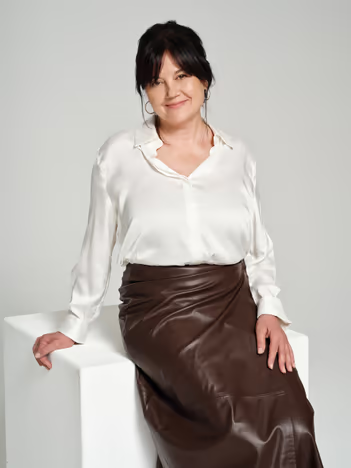
Dr Lucie Zárubová – a highly sought-after plastic surgeon specialising in breast surgery (augmentation, reshaping, reconstruction, etc.), and Head Surgeon at Premier Clinic. She performs more than 500 breast surgeries a year and, according to nationwide statistics on patient satisfaction and the popularity of plastic surgeons, ranks amongst the top three plastic surgeons for breast augmentation in the Czech Republic. She is an international trainer in surgical techniques.

Price List

Dermatoscopic examination of moles: 1 mole 660 Kč / 2 or more moles 1,320 Kč.

Laser removal of moles, growths and haemangiomas: 1st lesion 1,940 CZK each / 2nd and each subsequent lesion 1,280 CZK each.

Rejuvenation of the external female genitalia using a fractional CO₂ laser: 1st lesion 1,940 Kč each / 2nd and each subsequent lesion 1,280 Kč each.

Laser removal of warts: 2,530 CZK per lesion.

Book a consultation

Brighten your complexion without surgery

FAQ

Frequently Asked Questions

<p>Are you interested in fractional resurfacing? You’ll find answers to the most frequently asked questions here.</p>

Who is fractional resurfacing suitable for?

This treatment is suitable for you if you are troubled by skin pigmentation, scars, growths, birthmarks, warts, stretch marks or other skin imperfections.

It is also suitable for treating problematic skin affected by acne and enlarged pores.

It also has excellent rejuvenating effects, as well as preventative ones, as, for example, the early removal of warts helps to prevent health problems.

The advantage of fractional laser resurfacing over surgical procedures is that it minimises the strain on the body.


How long do the results of resurfacing last?

It depends on the intensity of the treatment, your genetic predisposition, your skincare routine and your lifestyle. However, the results can last for several years.


Are there any risks or complications following fractional laser treatment?

During the procedure, the skin may be damaged by laser radiation, leading to scarring or changes in pigmentation. Other risks include the spread of bacterial infection, the development of cold sores and milia. These complications can be prevented by choosing a reputable clinic and an experienced doctor.


What is the most important thing to bear in mind whilst the skin is healing following CO₂ laser treatment?

The most important thing is to keep the treated area clean and well moisturised. It is essential to protect the skin from direct sunlight afterwards.


Is there an alternative to this procedure?

It always depends on the specific issues you wish to address. During your consultation, you will choose the most suitable procedure together with your doctor. Are scars or stretch marks your concern, or are you interested in alternative treatments with a shorter recovery time? If so, SECRET microneedle radiofrequency or IPL photorejuvenation may be suitable options for you. If you are looking for more significant facial rejuvenation, options to consider might include eyelid surgery or double chin removal. We perform both procedures at our clinic.

Privacy and cookies settings 🍪

This website uses cookies to provide services, personalise adverts and analyse website traffic.


By selecting the option below, you agree to our privacy and cookies policy. You can change your settings at any time.

Settings